![]()
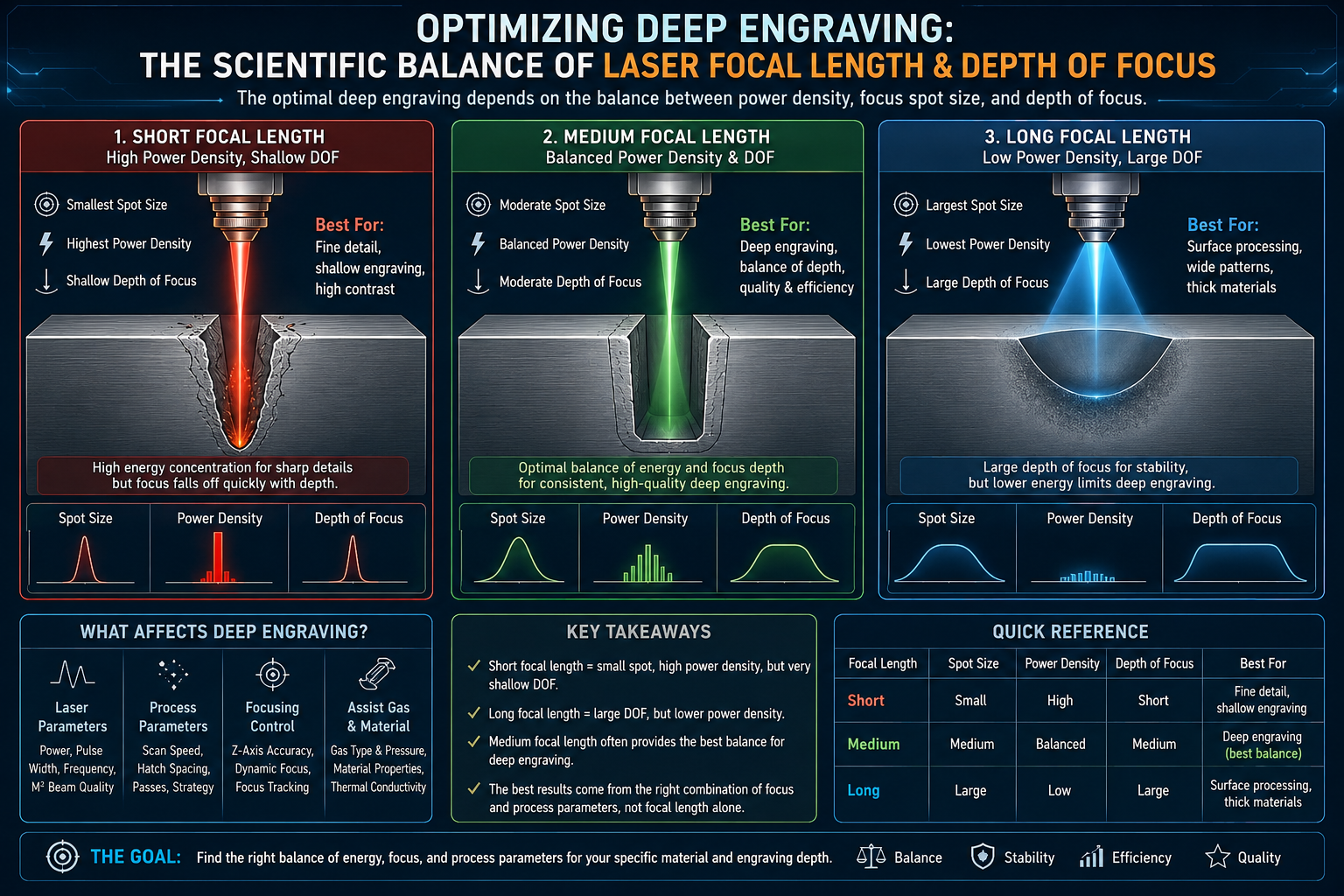
A customer asked: I want to perform deep engraving of 2mm on a 50×50mm product. Using a short focal length f-theta lens ensures a small focused spot and concentrated energy, so it will definitely engrave deeper, right?
My response was: Quite the opposite.
I. The Customer's Logic — Sounds Reasonable
The customer's line of reasoning was:
Short focal length lens → Smaller focused spot → Higher energy density → Deeper engraving
The first three steps are correct. The problem lies in the last step: "High energy density" does not mean "Deeper engraving."
Laser deep engraving is not a one-time operation that finishes instantly at the focal point. It requires the laser to strip material layer by layer from the surface. For every 0.1mm engraved, the processing surface moves 0.1mm away from the focus. The most critical weakness of short focal length lenses—shallow depth of focus (DOF)—means that after engraving just a few tenths of a millimeter, the spot has already diverged significantly, and the energy density drops off a cliff, making it impossible to reach a 2mm depth.
II. Two Core Concepts: Focused Spot and Depth of Focus (DOF)
2.1 Focused Spot Diameter Φ₀
The smaller the focused spot, the more concentrated the energy and the stronger the single-point removal capability. Calculation formula:
Φ₀ = (4M²λf) / (πΦ)
- M²: Beam quality factor (about 1.3~1.8 for single-mode fiber lasers)
- λ: Laser wavelength (1.064×10⁻³mm for 1064nm fiber lasers)
- f: Focal length of the f-theta lens (mm)
- Φ: Input beam diameter (mm)
The customer's understanding that the smaller the focal length f, the smaller the spot Φ₀, is correct.
2.2 Depth of Focus DOF (Depth of Focus)
DOF refers to the total distance on both sides of the focal point where the spot radius grows to √2 times (area doubles, energy density drops to 50%). Within this range, the laser still maintains effective processing capability. Calculation formula:
DOF = (2πw₀²) / (M²λ)
Where w₀ = Φ₀/2, is the radius of the focused spot.
The smaller the spot, the shallower the DOF — this is where the contradiction lies.
2.3 The Contradiction Revealed by a Formula
Substituting the spot radius w₀ = 2M²λf/(πΦ) into the DOF formula:
DOF = 2πM²λ × [ (2M²λf) / (πΦ) ]² = (8M²λf²) / (πΦ²)
See that? DOF is proportional to f². When the focal length doubles, the DOF increases fourfold. Conversely, when the focal length is halved, the DOF is only 1/4.
This is the key point the customer overlooked: You traded the short focal length for a small spot, but lost even more depth of focus.
III. Data Comparison: Three Focal Lengths
Using a 1064nm fiber laser as an example, M²=1.5, input beam Φ=7mm (typical value for fiber laser galvanometer systems):
Parameter | F=70mm (50×50 lens) | F=160mm (110×110 lens) | F=254mm (175×175 lens) |
Focused Spot Φ₀ | 20.3 μm | 46.4 μm | 73.7 μm |
Spot Area | 1.0 (Base) | 5.22x | 13.17x |
Energy Density | Highest | 19% | 8% |
Theoretical DOF | 0.406 mm | 2.12 mm | 5.35 mm |
Key Findings:
- The short focal length lens with F=70mm has a theoretical DOF of only 0.406mm — it can't even reach 0.5mm.
- The medium focal length lens with F=160mm has a theoretical DOF of 2.12mm — covering the 2mm depth, but energy attenuation at the bottom is obvious.
- The long focal length lens with F=254mm has a theoretical DOF of 5.35mm — providing ample coverage for 2mm depth.
IV. What Happens at 2mm Depth?
Deep engraving is not completed on the focal plane, but is a process of going layer by layer from the surface downwards. As depth increases, the processing surface gets further from the focus, and the spot begins to diverge.
4.1 When focus is on the surface: Weaker as it goes deeper
Let's calculate: When the focus is aligned with the material surface, how does the energy density change as depth increases?
F=70mm lens (Rayleigh range zR=0.203mm):
w(2mm) = w₀√(1+(2/0.203)²) = w₀ × 9.89
The spot area expanded by 97.8 times, and the energy density dropped to 1.0% of the focus. When the laser hits a depth of 2mm, the energy is almost zero — it can't engrave at all.
F=160mm lens (Rayleigh range zR=1.062mm):
w(2mm) = w₀√(1+(2/1.062)²) = w₀ × 2.13
The spot area expanded 4.55 times, and the energy density dropped to 22.0% of the focus — it can barely work, but the efficiency is already very low.
F=254mm lens (Rayleigh range zR=2.676mm):
w(2mm) = w₀√(1+(2/2.676)²) = w₀ × 1.25
The spot area expanded only 1.56 times, and the energy density still maintains 64.2% of the focus — still efficient.
The comparison is clear: At 2mm depth, the energy for the short focal length lens is only 1%, while the long focal length lens still has 64%.
But wait — the calculation above has a premise: the focus is aligned with the material surface. In actual processing, experienced masters never set it this way.
4.2 Positive Defocus: Hiding the focus inside the material
Any master who has done deep engraving knows this operation: first focus on the material surface, confirm the focus position, then shake the Z-axis (column) down by 1mm, letting the focus sink into the material, and then start processing.
This is called positive defocus — the focus is not on the material surface but inside the material.
Why do this? Because the energy distribution of a Gaussian beam is symmetrical centered on the focus: at equal distances above and below the focus, the spot size and energy density are the same. Therefore, for a 2mm deep process, by setting the focus at a depth of 1mm (the midpoint of the depth), then:
- Surface (z=0) is 1mm from the focus → energy density is a certain value
- Bottom (z=2mm) is also 1mm from the focus → energy density = exactly the same
The energy density at the surface and bottom is identical — this is the power of positive defocus.
F=160mm lens, Comparison before and after 1mm positive defocus:
Processing Depth | Focus on Surface | 1mm Positive Defocus | Change |
0mm (Surface) | 100% | 53.0% | Surface energy drops |
0.5mm | 81.8% | 81.8% | No change |
1.0mm | 53.0% | 100% | Highest energy here |
1.5mm | 33.4% | 81.8% | ↑ Significant increase |
2.0mm (Bottom) | 22.0% | 53.0% | ↑ 2.4x increase |
F=254mm lens, Comparison before and after 1mm positive defocus:
Processing Depth | Focus on Surface | 1mm Positive Defocus | Change |
0mm (Surface) | 100% | 87.7% | Only dropped 12% |
0.5mm | 96.6% | 96.6% | No change |
1.0mm | 87.7% | 100% | Highest energy here |
1.5mm | 76.1% | 96.6% | ↑ Increase |
2.0mm (Bottom) | 64.2% | 87.7% | ↑ 37% increase |
After positive defocus, the energy is almost above 87% throughout the process, making it very uniform and efficient. This is the most worry-free solution.
But even positive defocus can't save the F=70mm lens:
Processing Depth | Focus on Surface | 1mm Positive Defocus |
0mm (Surface) | 100% | 4.0% |
0.5mm | 14.2% | 14.2% |
1.0mm | 4.0% | 100% |
1.5mm | 1.8% | 14.2% |
2.0mm (Bottom) | 1.0% | 4.0% |
After positive defocus, the focus at 1mm depth is 100%, but the surface and bottom are only 4% — the depth of focus is simply too shallow.
4.3 Core Rule of Positive Defocus
Setting the focus at the midpoint of the processing depth is the most basic operational skill for deep engraving:
Offset = Target Depth / 2
- Engraving 2mm deep → Offset 1mm
- Engraving 1mm deep → Offset 0.5mm
- Engraving 3mm deep → Offset 1.5mm
The premise of positive defocus is: the depth of focus of the f-theta lens must at least be able to "reach" both ends of the processing depth.
V. Real Performance of Short Focal Length: Getting Shallower and Shallower
Using an F=70mm short focal length lens for deep engraving, the most typical phenomenon is that it gets shallower and shallower as it engraves:
Processing Depth | Spot Expansion Factor | Energy Density (% of Focus) | Actual Effect |
0mm (Surface) | 1.00x | 100% | Normal engraving |
0.1mm | 1.11x | 80.5% | Passable |
0.2mm | 1.40x | 50.8% | Noticeably shallower |
0.3mm | 1.78x | 31.5% | Barely |
0.5mm | 2.66x | 14.2% | Hardly engraves |
0.8mm | 4.06x | 6.1% | Basically ineffective |
1.0mm | 5.02x | 4.0% | Completely ineffective |
2.0mm | 9.89x | 1.0% | Completely unable to engrave |
F=254mm lens (Data when focus is on surface):
Processing Depth | Spot Expansion Factor | Energy Density (% of Focus) | Actual Effect |
0mm (Surface) | 1.00x | 100% | Normal engraving |
0.5mm | 1.02x | 96.6% | No difference |
1.0mm | 1.07x | 87.7% | No difference |
1.5mm | 1.15x | 76.1% | Almost no difference |
2.0mm | 1.25x | 64.2% | Still efficient |
3.0mm | 1.50x | 44.3% | Passable |
5.0mm | 2.12x | 22.3% | Barely |
VI. How to Find Balance in Contradiction?
Core contradiction of deep engraving:
- Small spot needs short focal length → Shallow depth of focus → Cannot engrave deep
- Large depth of focus needs long focal length → Large spot → Low energy density
The key to balance lies in ensuring the theoretical depth of focus can cover both ends of the processing depth, cooperating with positive defocus techniques, and then pursuing the smallest spot possible.
6.1 Selection Principle: Depth of Focus Priority + Positive Defocus
Theoretical DOF ≥ Target Depth is the minimum requirement.
Target Depth | Positive Defocus Amount | Min Requirement DOF | Recommended Focal Length |
0.2mm | 0.1mm | ≥0.2mm | F=70mm barely (DOF=0.41mm) |
0.5mm | 0.25mm | ≥0.5mm | F=100mm, F=160mm recommended |
1.0mm | 0.5mm | ≥1.0mm | F=160mm (DOF=2.12mm) |
2.0mm | 1.0mm | ≥2.0mm | F=254mm (Defocus 1mm) |
3.0mm | 1.5mm | ≥3.0mm | F=254mm (Defocus 1.5mm) or Z dynamic |
5.0mm | 2.5mm | ≥5.0mm | F=254mm boundary, Z dynamic recommended |
6.2 Beam Expander: Use with caution, not a panacea
If adding a 2× beam expander before an F=160mm lens (Φ from 7mm to 14mm):
Parameter | F=160mm, No Expander | F=160mm, +2× Expander |
Focused Spot | 46.4 μm | 23.2 μm (Halved) |
Theoretical DOF | 2.12 mm | 0.53 mm (Shrunk 4x) |
Correct understanding of beam expanders: Spot and depth of focus are a pair of seesaws. In deep engraving scenarios, you cannot sacrifice depth of focus to trade for a small spot.
6.3 The Real Ultimate Solution: Z-axis Dynamic Focusing
A more advanced solution is to let the focus follow downwards:
- Z-axis Dynamic Focusing: Every time a certain depth is engraved, the Z-axis moves down automatically, keeping the focus always on the processing surface.
VII. Practical Advice: Solution for 50×50mm Product to 2mm Depth
Scheme | F-theta Lens | Focus Strategy | Spot | Min Energy (0~2mm) | Evaluation |
Scheme A | F=254mm | Positive Defocus 1mm | 73.7μm | 87.7% | Recommended. Simple & Reliable |
Scheme B | F=160mm+Z | Z Dynamic Focus | 46.4μm | Follow | Highest precision, needs Z-axis |
Scheme C | F=160mm | Positive Defocus 1mm | 46.4μm | 53.0% | Usable. Increase power properly |
✗Scheme D | F=70mm | Positive Defocus 1mm | 20.3μm | 4.0% | Completely unable to engrave |
VIII. Summary
Myth | Fact |
Short focal lens spot is small, so it engraves deep | Small spot != deep engraving. If DOF is insufficient, energy drops off a cliff. |
Focus must be aligned with material surface | Positive defocus (focus at middle depth) is the basic operation. |
F=70mm lens is suitable for deep engraving | Theoretical DOF is only 0.41mm, completely unusable for deep engraving. |
F=160mm lens is barely enough for 2mm deep | After 1mm positive defocus, min energy is 53%, usable. |
Choose shortest focal length for deep engraving | Prioritize medium-long focal lengths with ample DOF, combined with positive defocus. |
Adding beam expander shrinks spot and keeps DOF | Shrinking spot inevitably shrinks DOF, counterproductive. |